Gliese Capital Fund Management
The whole back office of an alternative-investment fund — sourcing, modelling, valuation, capital calls, waterfalls, LP reporting — collapsed into one tenant-scoped platform, with an agentic MCP layer no incumbent has.
 Gliese
A Carta-plus-Atominvest for an alternative-investment fund, with a grounded AI layer bolted on — built from the inside, by the person who runs the fund’s capital markets and technology.
Context
Gliese Capital Fund Management (internal codename SINTAX) is the operating platform I built to run Gliese Capital, the alternative-investment fund where I'm Head of Capital Markets & Technology. It replaces the usual patchwork — Excel models, a legacy fund-admin tool, a document store, a separate LP-reporting service — with a single multi-tenant system a firm can source, vet, value, administer and report a whole portfolio from.
The product spans the full fund lifecycle: a configurable deal engine (PE, credit, real estate, infra, VC, life sciences), a dependency-aware DAG calculation engine for financial models, a valuation engine (DCF, comps, precedents, LBO), full fund administration (capital calls, distributions, European/American waterfalls, management-fee and carry logic, NAV, per-LP capital accounts), portfolio and risk analytics (IRR / TVPI / DPI / RVPI, VaR, Monte Carlo, concentration, ESG/SFDR), and a white-labelled LP portal. Everything is tenant-scoped, audit-trailed, and computed in Decimal so money is never touched by floating point.
What I built
- A fund-administration engine — capital calls, distributions, European/American waterfalls with catch-up and clawback, management-fee step-downs and carried-interest tracking, NAV, and per-LP capital-account statements.
- A DAG calculation engine — a dependency-aware graph where changing one input recalculates everything downstream, with override tracking, circular-reference rejection, versioning, and per-deal-type templates (LBO, credit, real estate, VC, infra).
- A white-labelled LP portal — fund-performance dashboard, capital account, capital-call response, document centre, e-signatures and transfers, branded per tenant.
- Four surfaces on one API — a Next.js admin console + LP portal, the REST API, a sntx CLI, and an MCP server so agents can drive the platform with changeset rollback.
- Portfolio, risk & compliance — IRR / TVPI / DPI / RVPI analytics, VaR / Monte-Carlo / concentration risk, and jurisdiction-aware compliance (Form PF/ADV, AIFMD, SFDR).
- An AI intelligence & memory layer — grounded, provenanced extraction and commentary where LLMs write prose over numbers computed in Decimal SQL and never do the arithmetic.
How it's built
A pnpm monorepo with three apps behind one tenant-scoped contract: a Next.js 14 App Router frontend (admin console + LP portal), a NestJS 11 API of 54 domain modules — funds, cap-table, valuation, credit-analysis, compliance, ingestion, integrations and more — and a Python 3.12 / FastAPI AI service running LangGraph / LiteLLM / LightRAG. The same REST API backs all four human and machine surfaces (web, CLI, MCP), so an agent and an analyst hit identical, audited endpoints.
The engineering discipline is the interesting part. Multi-tenancy is enforced on every query via a (tenant, entity_type, entity_id) scope key with schema-per-tenant Postgres isolation; all monetary maths is Decimal, never float; every mutation to a deal, fund or valuation is written to an immutable audit trail; and the calc engine validates DAG acyclicity on every formula change. The AI layer is deliberately constrained — outputs are grounded and provenanced, each synthesised fact linking back to a source document, event and timestamp, with deterministic Decimal-SQL computing the numbers the models only narrate.
Outcome
A working, audit-hardened platform — the core calc, fund-admin, cap-table, valuation and credit engines are institutional-grade, backed by 271 API test suites / 4,426 tests (plus ~1,419 web and 25 MCP tests) with 72 internal audit findings remediated. The build plan frames it honestly as roughly 60% of the category-defining product it's aiming at — a Carta + Atominvest with an agentic memory layer — with the remaining tracks mapped out. It's real enough to run a fund on, and demonstrates end-to-end command of institutional finance, multi-tenant SaaS architecture, and grounded AI.
Core feature
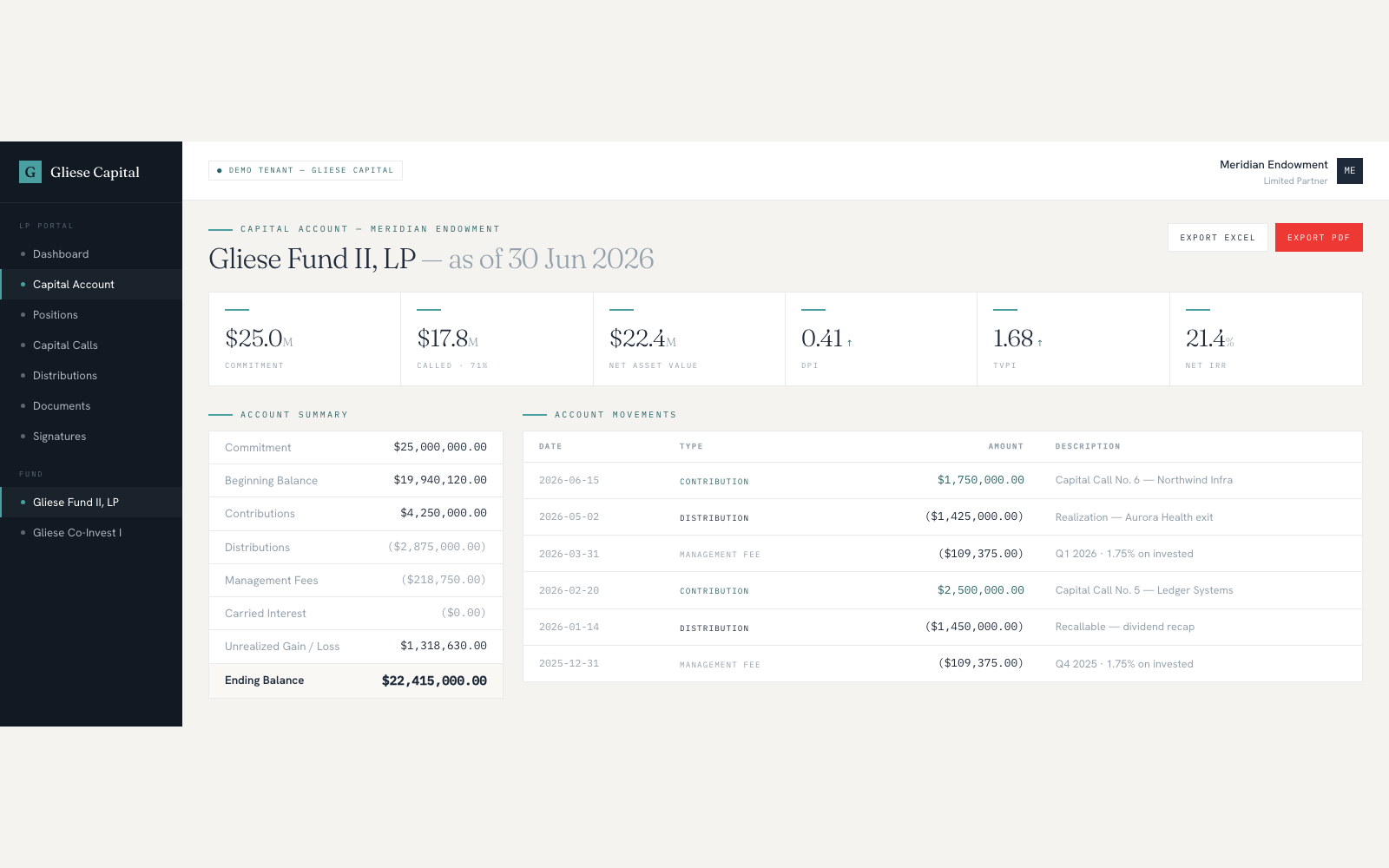
The LP portal's capital-account surface — fund-level performance tiles (commitment, called, NAV, DPI / TVPI / IRR) over a full capital-account summary and a movements ledger of contributions, distributions, fees and carry. The real Gliese “data ledger” look, figures in Decimal.
Gliese Fund II, LP — as of 30 Jun 2026
| Date | Type | Amount | Description |
|---|---|---|---|
| 2026-06-15 | Contribution | $1,750,000.00 | Capital Call No. 6 — Northwind Infra |
| 2026-05-02 | Distribution | ($1,425,000.00) | Realization — Aurora Health exit |
| 2026-03-31 | Management Fee | ($109,375.00) | Q1 2026 · 1.75% on invested |
| 2026-02-20 | Contribution | $2,500,000.00 | Capital Call No. 5 — Ledger Systems |
| 2026-01-14 | Distribution | ($1,450,000.00) | Recallable — dividend recap |
| 2025-12-31 | Management Fee | ($109,375.00) | Q4 2025 · 1.75% on invested |