claudepwn
One command turns a product spec into a fully configured, multi-agent Claude Code environment — ready to plan, build and harden itself.
 Claudepwn
From a PRD to a running multi-agent build in a single command — planning on Opus, implementing on Sonnet, closing on Haiku.
What it does
Given a product-requirements document and a target stack, claudepwn scaffolds a complete .claude/ environment, then has Claude read the PRD headless, decompose it into epics and sprints, write architecture-decision records, seed a documentation vault, and kick off the first sprint. For existing codebases it runs an audit first, opens a hardening sprint, then plans forward.
What I built
- Eight specialised agents — architect, implementer, tester, reviewer, security, docs, vault-keeper, dispatcher — coordinating asynchronously over a shared status board.
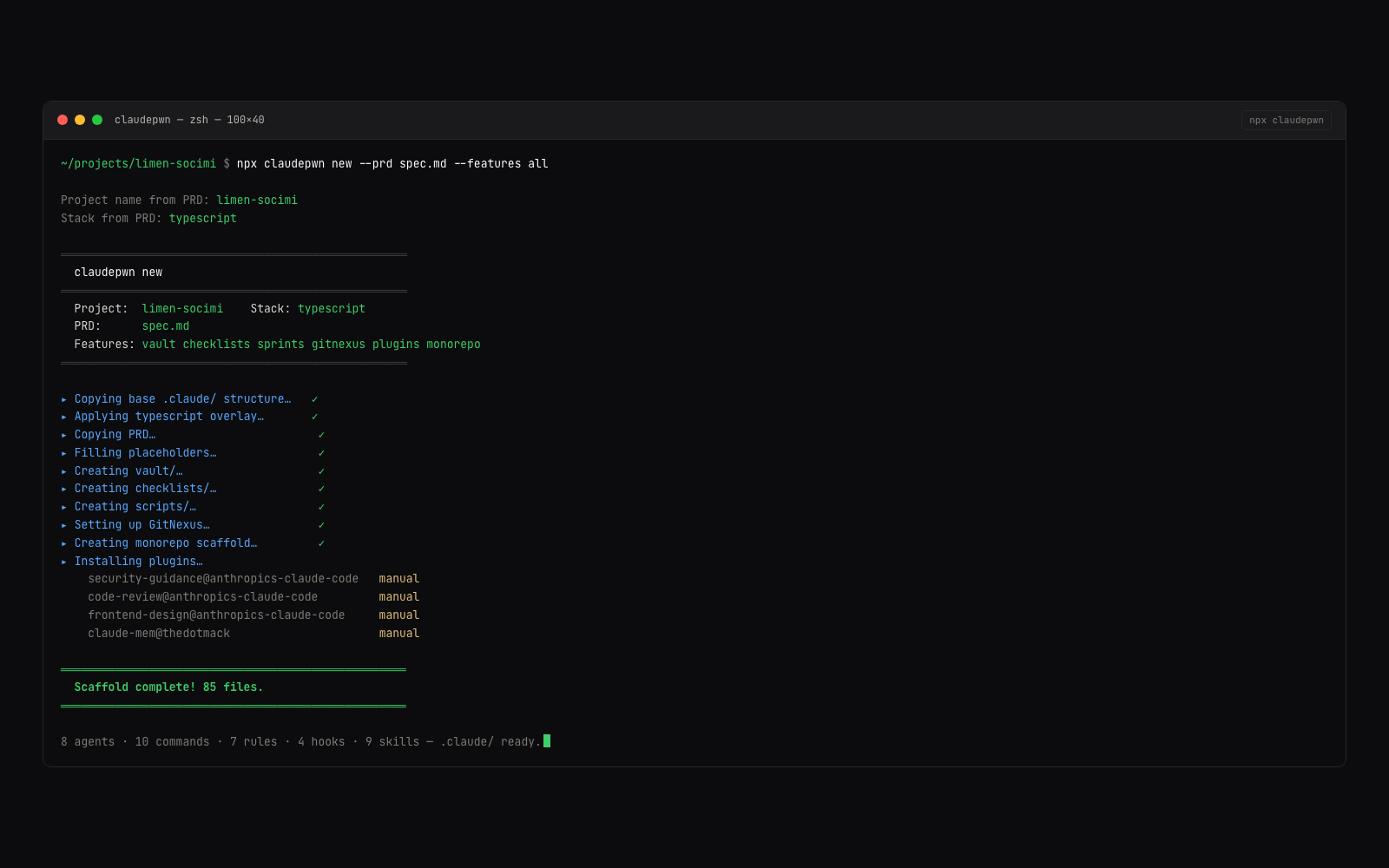
- Ten commands, seven coding rules, four lifecycle hooks and nine skills, generated as ~80 canonical files.
- Per-language stack overlays wiring the right lint / test / format / audit tools for Python, TypeScript, Rust and Go.
- An eight-wave hardening gate: pre-check → tests → security scan → code review → dependency analysis → docs sync → domain safety → PR review.
- A sprint runner that routes each phase to the right model tier for cost, and an optional Obsidian vault for ADRs and design knowledge.
How it's built
A thin Node CLI wraps a Bash orchestrator that scaffolds non-destructively, detects the stack from PRD keywords, and launches Claude headless with bootstrap prompts. Agents don't lock — they coordinate through append-only board and dispatch files, so work runs in parallel without deadlocks. A pre-commit hook regex-scans for secrets before anything reaches git, and an optional GitNexus knowledge-graph integration maps module boundaries for impact analysis.
Why it matters
It's the operating system for how I actually ship — the same multi-agent, hardened, model-routed cadence that produced most of the work on this site, packaged so anyone can run it.
Core feature
The real CLI in action: `npx claudepwn new` scaffolds a complete .claude/ environment — 85 files across eight agents, ten commands, seven rules, four hooks, nine skills, a vault and plugins — in one command, then hands off to Claude.